
Every economic shift eventually becomes a household decision. Economic shifts rarely stay within the pages of financial reports. They eventually find their way into everyday life, shaping how Filipino households budget, spend, save, and plan for the future.
Inflation influences what goes into the grocery basket. Exchange rate movements affect the value of overseas remittances. Interest rates determine whether families postpone major purchases or continue paying down debt. Individually, these are economic indicators. Collectively, they reveal how households adapt long before those changes become visible in sales reports or business performance.
For researchers, the challenge is no longer simply accessing economic data. It is understanding how movements in the broader economy eventually influence people’s decisions, and helping brands respond before those shifts become obvious.
As AI continues to reshape how knowledge work is done, we began asking ourselves a different question. Where could it meaningfully strengthen FastForward’s research process?
PH Pulse became one of our first experiments.
Can AI Build an Economic Monitoring System?
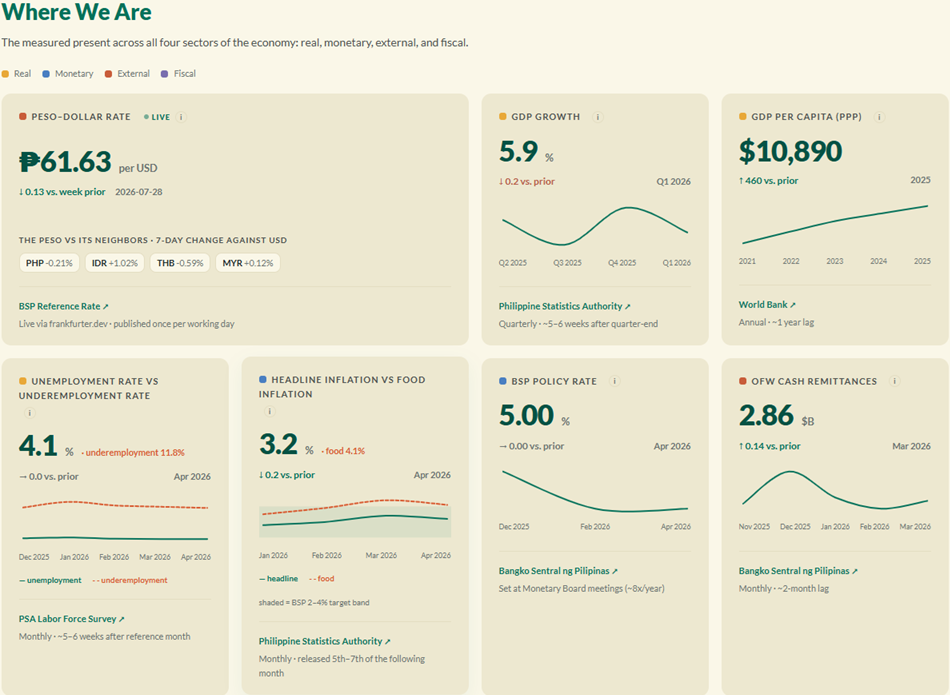
Our hypothesis was straightforward. If AI could automate the repetitive work of collecting, organizing, and updating economic indicators, researchers could spend less time maintaining data and more time interpreting what those signals mean for Filipino households, markets, and the businesses that serve them. The objective was never to build another dashboard. It was to create a living system that allows researchers to connect constantly changing economic realities unfolding on the ground.
From the outset, we focused on three dimensions that consistently shape consumer and business decisions:
- Household & Demand Signals, including employment, wages, inflation, remittances, and economic growth.
- Monetary & Financial Signals, such as exchange rates, policy rates, and foreign reserves.
- Fiscal & External Signals, covering government finances and global economic pressures.
Rather than treating these indicators as separate statistics, we wanted to understand how they interact and what story they tell together.
AI Still Needs a Source of Truth
We began the experiment knowing that AI would have limitations. What we wanted to understand was where those limitations would matter most in a research workflow. It quickly became clear that while AI excelled at organizing information and building automated workflows, it was far less dependable as a source of live economic data. Current figures still required verification against official sources, reinforcing an important principle at FastForward: in research, speed is valuable, but accuracy is non-negotiable.
Rather than seeing this as a constraint, we used it to redefine AI’s role within PH Pulse. Official institutions would remain the source of truth, while AI became the layer that structures, connects, and visualizes information in ways that make interpretation faster and more intuitive.
From Economic Indicators to Human Behavior
The pivot also forced us to ask a more important question. We were no longer trying to identify every available economic indicator. Instead, we wanted to identify the best set of signals that consistently explains how Filipino households experience constant economic change.
After all, the value of economic tracking does not lie in monitoring numbers for their own sake. Its value lies in understanding how those numbers eventually influence behavior. Inflation, for example, is not simply a measure of rising prices. Viewed alongside employment, wage growth, and remittance inflows, it begins to explain why households trade down to more affordable brands, postpone discretionary purchases, or become more deliberate in managing everyday expenses. Similarly, movements in interest rates or exchange rates are meaningful not because they fluctuate, but because they shape borrowing decisions, business confidence, and household purchasing power.
When viewed together, these indicators become more than economic statistics. They become early signals of changing consumer behavior. For us, that distinction matters. Markets do not change overnight. People do. Markets simply reflect those decisions over time.
Economic indicators become valuable when they help explain how people adapt.
What We Learned
The biggest lesson from the PH Pulse experiment was not about automation. It was about interpretation. AI proved most valuable when it helped organize complexity rather than eliminate it. By bringing together multiple economic signals into a single system, it became easier to identify relationships that might otherwise remain disconnected. Researchers could spend less time collecting information and more time asking better questions.
How does rising inflation affect confidence if employment remains stable?
Why do some economic improvements fail to translate into stronger household spending?
Which signals tend to move first before changes become visible in consumer behavior?
These are not questions AI can answer on its own yet. They require context, judgment, and an understanding of people that extends beyond the numbers themselves. Rather than replacing researchers, AI creates more space for researchers to do the work that matters most.
AI organizes information.
Researchers create meaning.
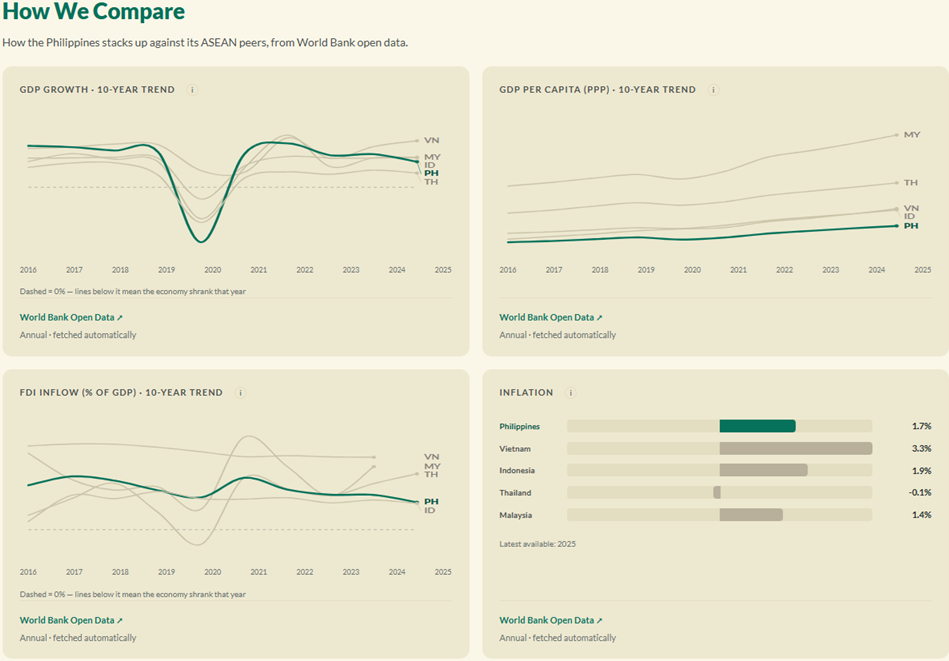
PH Pulse represents only one experiment in FastForward’s broader exploration of AI in research. Our next step is to move beyond macroeconomic indicators by layering behavioral, cultural, and sentiment signals onto the dashboard. Understanding what is happening in the economy is only part of the picture. The bigger opportunity lies in understanding how Filipinos are responding, adapting, and redefining their everyday decisions as conditions continue to evolve. That has always been the role of research.
Technology may change how information is collected and organized, but the purpose remains the same: helping organizations understand people better so they can make better decisions. As AI continues to evolve, we believe its greatest contribution will not be to replace human judgment, but to give researchers more time to exercise it.
The future of research is not about automating insight. It is about automating everything around it, so researchers can spend more time understanding people.
Interested in exploring PH Pulse? If you’d like a complimentary preview of the dashboard and learn how it can support your team’s understanding of the Philippine economy and consumer behavior, reach out to the FastForward Client Servicing Group (CSG). We’d be happy to arrange an introduction and walkthrough.