
Traditionally, the Filipino health journey has been episodic and straightforward. People reactively engage in health behaviors after getting sick: Consumers get sick, seek treatment, visit a doctor, buy medicine, then the journey ends.
The emerging Filipino health journey is becoming more continuous and closed-loop. For an increasingly health-conscious consumer, health is becoming something to manage continuously alongside the demands of work, family, social life, and everything else competing for attention and energy.

From Sick Care to Self-Management
For Filipinos who are into emerging sports and forms of exercise like pickleball and Hyrox, “health” is already part of everyday life. A Garmin or other tech-enabled wearable can influence whether someone trains harder or takes a rest day. Sleep data can shape the next morning’s workout or even mood. Recovery metrics can determine whether an athlete pushes through or holds back.
For the everyday consumer, the stakes may be less competitive but equally persistent. A full-time employee may squeeze a workout into an already packed schedule. A parent may track steps between work and household responsibilities. A young professional may track stress levels and recovery to understand whether they are actually recovering from demanding workweeks. These individuals may not call themselves hardcore athletes or even patients, yet they are constantly negotiating how health fits into their already crowded lives.
Locally, commercial, structural, and behavioral changes and evidence reflect the response to the emerging health framework of Filipinos.
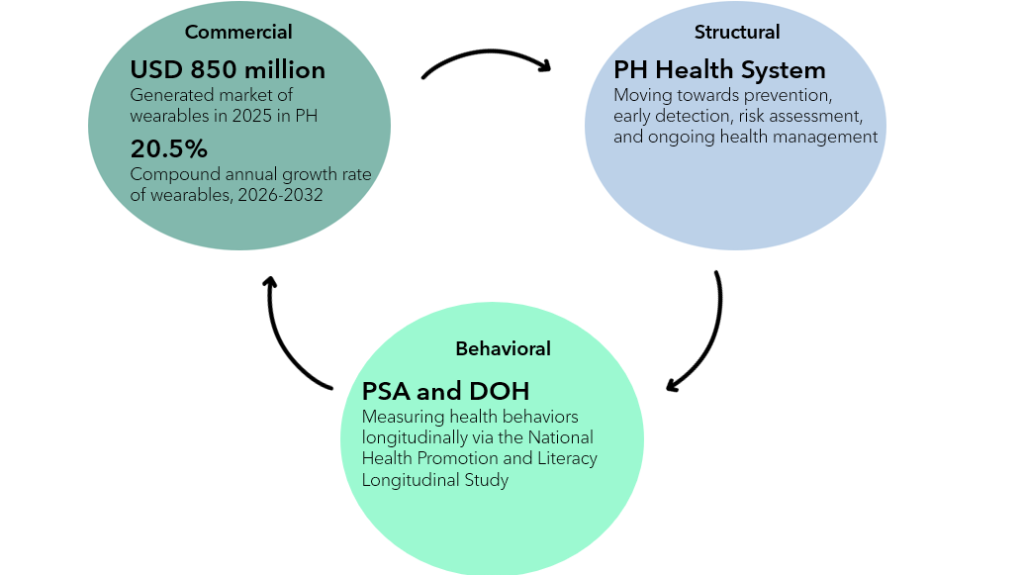
The Score Becomes the Motivation
This behavior becomes particularly visible in online Filipino fitness communities. Garmin scores, Strava running distances, Apple Watch sleep metrics, Samsung or Huawei recovery levels, and personal records are routinely shared, discussed, and compared by both casual Filipinos and serious healthmaxxers.

Garmin sleep scores are prevalent discussions in digital spaces. Getting a high score is a badge of honor.

Strava personal records (PRs) are flexed online.
The number itself is rarely the entire story. A new personal record is not simply proof that a person ran faster. It becomes evidence that something they did worked. A runner may post a new best time alongside the supplements they took, the shoes they trained in, or the nutrition strategy they followed. A gym-goer may credit a particular routine or product for visible progress.
Progress is the new persuasion. Consumers trust visible proof of progress more than another functional claim, and health products become part of that evidence.
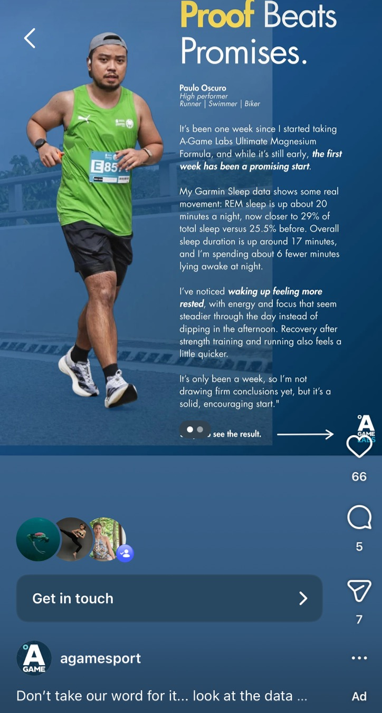
Case study: AGame Supplements x Garmin Sleep Score
AGame, a fitness brand that offers Magnesium products, tapped into Filipinos’ habit of tracking and sharing sleep scores by sponsoring “daily athletes and corporate weapons”. These active Filipinos posted their Garmin data alongside personal stories of how AGame’s magnesium helped them. This worked because it turned the supplement into visible proof of progress, evidence consumers trust more than functional claims.
The metric creates the feedback loop: behavior creates data, data creates proof, and proof gives consumers something to celebrate and brands something to participate in.
The Consumer Is Building a Health Ecosystem
Filipino consumers no longer experience health in neat categories. They build their own systems to achieve their goals.
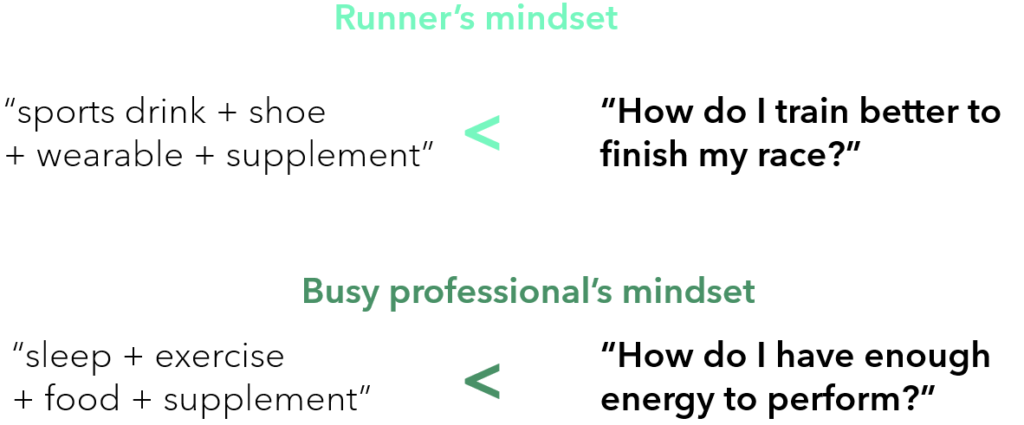
Similarly, a consumer looking to improve sleep may not distinguish among multivitamins, supplements, electrolytes, exercise, and sleep tracking.
Consumers organize around goals. Companies still organize around categories. This makes the contrast explicit and sharp.

Ashwagandha and Magnesium have become emerging health supplements for better sleep and relaxation. Same goal, different categories.
In the same train of thought, brands in different categories are all competing for the same underlying need: better recovery and performance the next day. The consumer’s goal, therefore, becomes a more useful lens than the category itself. Yet brands continue to defend categories, even as consumers shop by the problem they want solved. The opportunity is not simply to defend a category. It is to understand the larger goal the category is helping consumers achieve and the unmet needs surrounding that goal.
The New Health Relationship
Health is shifting from one‑time fixes to continuous systems, opening new ways for brands to build recurring relationships. Value now comes through products, services, or experiences, intensifying competition across categories. This mismatch is the strategic tension. Consumers shop by the problem they want solved (e.g., better recovery, more energy, improved sleep), while brands defend their categories. The real opportunity lies in embedding credibly within the consumer’s ongoing goal journey, not just within a product silo.
The strategic question has moved from ‘Should we launch a subscription?’ to ‘Which recurring job to be done or moment can we credibly own?’
At FastForward, we combine social signals from desk and composite research with primary research to uncover how health is truly lived. We believe offline conversations are shaped by online narratives, so reconciling digital signals with public discourse is essential for accurate consumer intelligence.
Our approach ensures insights are not just about consumers but genuinely for and about Filipinos. By calibrating digital signals, primary research, and category context into one coherent view, we ground strategies in real consumer realities so they connect with everyday life.
References:
Office of the President of the Philippines. (2024, June 4). Memorandum Circular No. 53: Adopting the National Objectives for Health 2023–2028 and directing the implementation thereof. Official Gazette. https://elibrary.judiciary.gov.ph/thebookshelf/showdocs/8/97479
Philippine Statistics Authority. (2026, July 21). PSA clears “Health Promotion and Literacy Longitudinal Study Phase IV,” encourages participation for data-driven health promotion policies and programs. Philippine Statistics Authority
Preventive Medicine Daily. (2026, January 15). Wearable technology & health tracking statistics 2026. Preventive Medicine Daily. https://preventivemedicinedaily.com/wearable-technology-health-tracking-statistics-2026
United States Patent and Trademark Office. (2026). Petition decision for application no. 1556254 [PDF]. USPTO Patent Trial and Appeal Case Tracking System. https://ptacts.uspto.gov/ptacts/public-informations/petitions/1556254/download-documents?artifactId=WkUf9JSF2bOQYgJD3wOqhIBJHRY7FTr8_S-cmapdK3yU9bNnB6bstgo