
Marketers and communicators have been talking about Gen Alpha for a few years now: the children of Millennials, the digital natives born after 2010, the so-called “AI generation”. But what if the conversation has always been missing the point?
Gen Alpha isn’t waiting to arrive; they’re already shaping how the digital world behaves. They’re growing up on platforms that older generations are still trying to understand: where Roblox is a social playground, AI is a classmate, and screen time is both the reward and the battleground.
This generation isn’t just consuming culture; they’re co-creating it. And in doing so, they’re forcing parents, educators, and yes, brands, to confront what happens when childhood, technology, and identity all merge in public view.
For marketers and PR professionals, understanding Gen Alpha isn’t about predicting future consumer behavior. It’s about recognizing early signals of how people, all people, will connect, express, and make choices in the years to come. Because every tension they live through today, between parent and child, between human and AI, play and purpose, is a preview of the next cultural wave brands will need to navigate.
Parenting in Public: The New Growing Pains of the Digital Household
Millennial parents are raising the first generation of children who have never known life offline, and it shows. Across social feeds and living rooms, the parenting-child dynamic has gone public, exposing a new set of growing pains for both sides.
Screen-time battles are now a family sport. Parents fear digital addiction, while kids see screens as their classroom, playground, and social circle all in one. The argument isn’t just about minutes (or even hours) spent on a device, but what counts as meaningful use. For this generation of iPad kids, a YouTube tutorial can feel as valuable as a textbook, and Roblox can be as social as a playdate. Parents keep urging them to go outside and “touch grass”, while kids insist their digital world is just as real as their physical one.
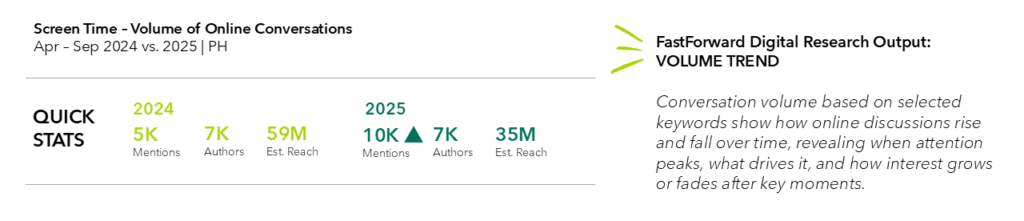
Online chatter on kids’ screen use nearly doubled vs. 2024, reflecting fatigue, guilt, and shifting views on digital learning. Majority of the 10K mentions on the topic this year is driven by parenting pages and mom communities on Facebook, where screen time sparks the most emotional debate, and where parenting norms are publicly renegotiated everyday.
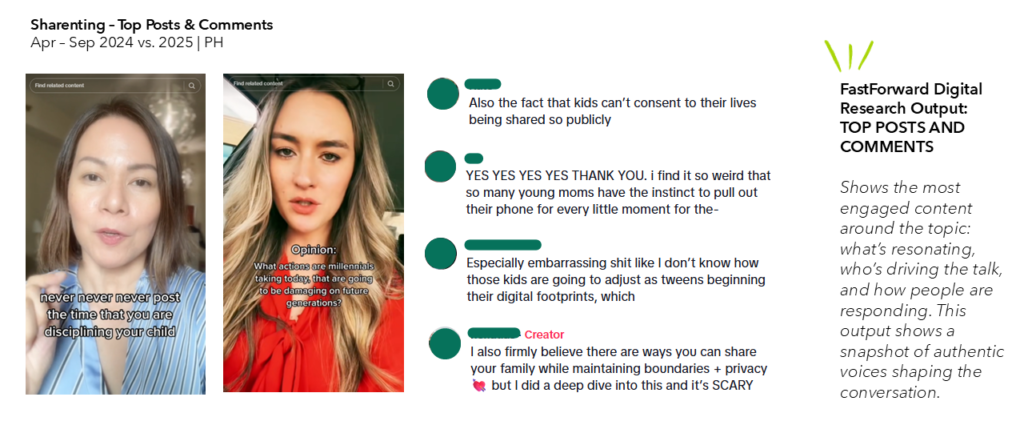
And then there’s sharenting, the Millennial parent’s digital scrapbook that starts before birth. For Gen Alpha, baby photos, milestones, and tantrums are often uploaded before they can even consent. As they grow older, they’re inheriting not just the digital fluency but digital footprints. Marketers may soon face an audience who’s hyper-aware of how much of themselves is online, and skeptical of anyone who treats identity as content.
In local parenting communities, sharenting debates often trend around privacy and consent, with spikes following viral TikToks of parents posting emotional or disciplinary moments. Many users are expressing discomfort, using terms like “exploiting kids” or “walang consent”, reflecting a growing shift towards mindful digital boundaries.
Online, topic sparks backlash as millennial parents confront the cost of growing up online. The sharenting debate reflects a broader parental reckoning online. Conversations have shifted from celebration to caution, as digital footprints become family legacies children will one day inherit.
The gender-neutral shift is yet another quiet rebellion. Gen Alpha isn’t interested in your pink-for-girls, blue-for-boys rules. They’re growing up dressing avatars, choosing pronouns, and expressing fluid identities in digital spaces where self-presentation and self-expression can change daily.
And while the internet celebrates gentle parenting, behind the hashtags lies exhaustion. Millennial parents, the first to parent under constant online scrutiny, are pushing back. From “be kind” to “FAFO” (f— around and find out), we’re seeing the pendulum swing between over-empathy and tough-love realism.
These tensions aren’t isolated trends. Together, they signal a culture shift where family life itself is content, curated, commented on, and contested in real time. For brands, this means that storytelling must move carefully. The modern family isn’t an idealized unit anymore, but a live negotiation of values, boundaries, and bandwidth.
Born with the Bot: The First AI-Native Generation
For Gen Alpha, AI isn’t new technology; it’s background noise. They’re the first generation to grow up with algorithms that learn from them, recommend to them, and sometimes create for them. From AI tutors that correct homework to filters that perfect selfies, artificial intelligence quietly shapes how they learn, play, and imagine.
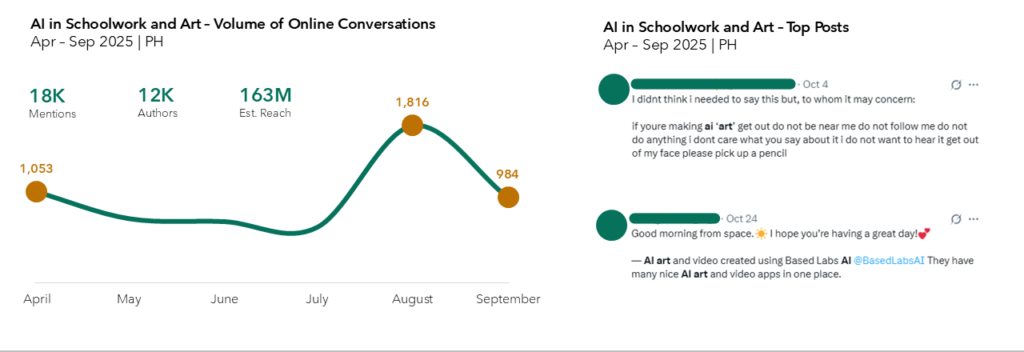
But the deeper story isn’t just access — it’s ambivalence. Gen Alpha moves fluidly between fascination and frustration with the machines around them. Social listening echoes this sentiment. Online conversations about AI in education and creativity have surged, driven by both excitement and ethical unease. Filipino users alternate between celebrating AI for “saving time” and criticizing it for “killing creativity”.
AI enters the classroom and the canvas. Conversations surge online as Gen Alpha redefines effort and creativity.
AI tools have simplified schoolwork—and blurred its boundaries. For Gen Alpha, homework bots and essay helpers are everyday tools. Some use them to learn; others to shortcut. What adults call cheating, they often see as smart efficiency. They’re redefining “effort” in a world of instant help.
For this generation, AI isn’t a future-facing tool, but a toy. They use it to design Roblox worlds, remix TikTok captions, or generate anime avatars. The line between creativity and automation doesn’t bother them; the outcome does. If the result looks cool, then that’s enough. In this sense, AI becomes an invisible collaborator, a co-player rather than a threat.
Art, stories, and fan edits made with AI have become status symbols in Gen Alpha spaces. Yet beneath the excitement sits a new tension: Who gets credit when creativity is co-authored with code? Teachers wrestle with plagiarism rules, while kids argue that “prompting” is its own kind of skill. For many, AI is a creative shortcut, but it’s also a lesson in ownership, originality, and ethics.
Beneath the playfulness lies a quiet anxiety. Exposure to automation early means Gen Alpha is already confronting questions most adults are just beginning to ask: “If AI can do everything better, what’s my place in the future?”. That fear surfaces in school essays, online comments, and TikTok rants, revealing a generation both inspired and unsettled by their technological twin. Across local and global conversations, Gen Alpha’s posts about AI occasionally carry a tone of existential curiosity: not fear, but uncertainty. Keywords like “replace”, “real artist”, and “future job” hint at early techno-anxiety surfacing in youth conversations.
As they grow up alongside machines that think, draw, and decide, Gen Alpha is learning that the future isn’t about competing with AI, but about coexisting with it. AI has become both their collaborator and their mirror, reflecting their values around effort, creativity, and control.
The question that defines them isn’t “Can I keep up?” but “What makes me different?”. This generation is learning not only from AI but also against it, defining what still makes them distinctly human in a world of infinite automation.
Signs of Emerging Subcultures: Worlds Where Gen Alpha Build Themselves
If Millennials grew up with social media and Gen Z came of age with influencers, Gen Alpha is growing up inside worlds they can build. Their identities aren’t confined to profiles or feeds; they live across games, fandoms, servers, and platforms that let them customize not just how they look, but who they are.
For Gen Alpha, play is personality. Games like Roblox and Minecraft are identity labs where avatars reflect mood, style, and belonging. Here, play is creation and connection and design becomes self-expression; customization signals autonomy. The urge to tweak an outfit today may evolve into curating digital presence tomorrow. These kids aren’t just players, they’re early architects of their own digital worlds.
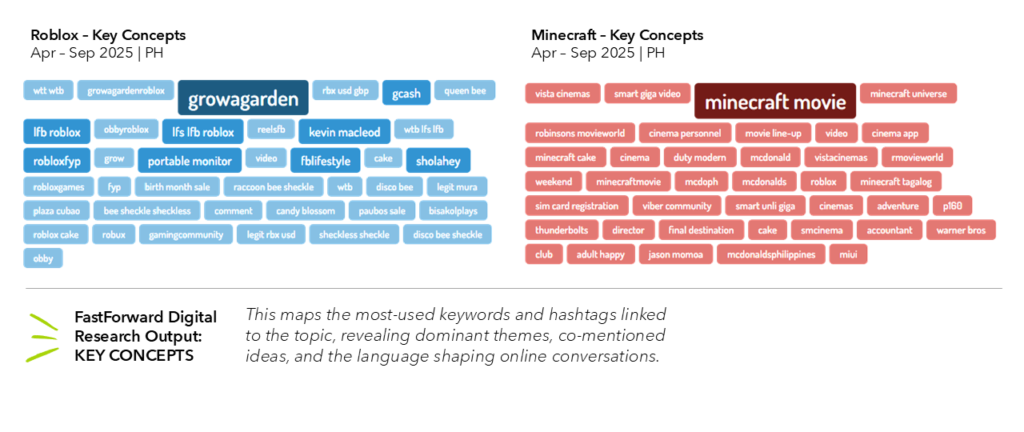
Inside these games, Gen Alpha is already learning what older generations call entrepreneurship. They practice digital barter and commerce at its finest, with an economy built on skins, accessories, and even entire game experiences. Many have built small economies, with virtual earnings that blur the line between play and profit. Collaboration is currency, where you can co-create a game map or skin to bring social status within the friend network. It’s capitalism, community, and creativity all rolled into one — all inside a digital playgournd.
Beyond gaming, their digital neighborhoods thrive on TikTok trends, Discord hangouts, and YouTube fandoms. These spaces have become cultural incubators, where language evolves, humor mutates, and micro-trends are born overnight. Here, kids don’t just consume content; they remix it. A meme becomes a manifesto; a fancam vid becomes a social statement. Their humor is chaotic but revealing: it celebrates irony, inside jokes, and self-awareness, all tools for navigating an internet that’s increasingly crowded and parasocial.
Digital intelligence also surfaces the rise of niche of digital tribes: smaller fast-evolving communities on TikTok and Discord where belonging is built through shared creation. On TikTok, edit-core kids remix fandoms into aesthetic micro-films, while mini-makers use AI and design tools as creative playgrounds. On Discord, young moderators and server builders manage intimate hubs for gaming, study, and support: early rehearsals of digital leadership. Together, these micro-communities show how this generation turns every platform into a space for identity, collaboration, and connection.
For Gen Alpha, self-expression is not about rebellion, but about creation. They don’t want to break the system; they want to personalize it. They’re forming digital subcultures that blend gaming, art, and social activism, spaces where collaboration replaces competition and identity is always in beta.
The next youth culture isn’t forming in just malls or classrooms; it’s happening in multiplayer lobbies and shared servers. To understand Gen Alpha is to understand the worlds they’re building, because those worlds are already building them back.
If You Want to Understand Us, Log In
Gen Alpha isn’t the future; they’re the present, quietly rewriting the rules of creativity, play, and connection while the rest of the world is still debating screen time. They’re growing up in spaces where imagination and identity are intertwined, where AI is a tool, not a threat, and where culture is built collaboratively online, not broadcast from the top down.
And if the world still doesn’t quite understand them, they have an answer of their own: